
importance of fiducial marks in Pc board assembly
In the intricate world of PC board assembly, where precision and accuracy are paramount, fiducial marks emerge as essential guiding elements facilitating the seamless integration of components onto the PCB. These small, strategically placed reference points serve as navigational aids for automated assembly equipment, ensuring precise alignment and placement of components throughout the assembly process. In this article, we delve into the importance of fiducial marks in PC board assembly and their role in achieving high-quality, reliable electronic devices.
At its core, fiducial marks are visual landmarks designed to provide precise positional information to assembly equipment, such as pick-and-place machines and solder paste printers. These marks typically consist of circular or cross-shaped patterns etched onto the PCB surface, with known dimensions and coordinates relative to the PCB’s coordinate system. By accurately locating fiducial marks during the assembly process, automated equipment can determine the PCB’s orientation, position, and scale, ensuring accurate component placement and solder paste deposition.
One of the primary functions of fiducial marks is to compensate for inaccuracies and variations inherent in the pc board assembly fabrication process. PCBs are subject to manufacturing tolerances, dimensional variations, and distortions caused by factors such as thermal expansion and mechanical stress. Fiducial marks provide reference points that enable assembly equipment to adapt and compensate for these variations, ensuring consistent and precise component placement regardless of minor deviations in PCB dimensions or alignment.
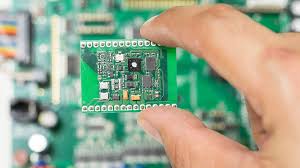
Can you explain the importance of fiducial marks in Pc board assembly?
Moreover, fiducial marks play a crucial role in facilitating the registration and alignment of multiple layers in complex PCB assemblies. In multilayer PCBs, where components are mounted on both sides of the board, fiducial marks help align the different layers accurately during assembly, ensuring proper registration and alignment of components across the entire assembly. This is particularly critical for high-density PCBs with fine-pitch components, where even slight misalignment can lead to assembly defects and reliability issues.
Another important function of fiducial marks is to enable fiducial-based vision systems to calibrate and adjust for perspective distortion during component placement. Vision-based assembly equipment utilizes cameras and image processing algorithms to locate fiducial marks on the PCB surface and determine the board’s position and orientation in three-dimensional space. By analyzing the position and shape of fiducial marks in captured images, vision systems can correct for perspective distortion and ensure accurate component placement, even on irregularly shaped PCBs or substrates.
Furthermore, fiducial marks serve as reference points for verifying the accuracy and precision of the assembly process through post-placement inspection. Automated optical inspection (AOI) and other inspection techniques rely on fiducial marks to align captured images with the PCB’s coordinate system, enabling accurate defect detection and analysis. By comparing the actual positions of components with their intended positions based on fiducial marks, manufacturers can identify and address assembly defects, such as misaligned components or solder bridges, to ensure product quality and reliability.
In conclusion, fiducial marks play a vital role in PC board assembly by providing precise positional information and facilitating accurate component placement and solder paste deposition. These small reference points enable automated assembly equipment to compensate for variations in PCB fabrication, align multiple layers in complex assemblies, and calibrate vision systems for accurate perspective correction. By serving as navigational aids throughout the assembly process, fiducial marks ensure the high-quality, reliable performance of electronic devices, meeting the stringent demands of today’s electronics industry.