
printed circuit board assembly
Printed Circuit Board Assembly (PCBA) lies at the heart of modern electronics, serving as the foundation upon which electronic devices are built. At its essence, PCBA is the process of assembling electronic components onto a printed circuit board (PCB) to create a functional electronic system. But what exactly does this entail, and why is it so crucial in the realm of electronics?
A printed circuit board assembly, or PCB, is a flat board made of non-conductive material, typically fiberglass-reinforced epoxy, with thin layers of conductive copper traces laminated onto its surface. These traces form a precise circuit pattern that connects the various electronic components mounted onto the PCB, facilitating the flow of electricity and enabling the device to perform its intended functions.
The process of Printed Circuit Board Assembly begins with the fabrication of the PCB itself. This involves designing the circuit layout using specialized software and etching the copper traces onto the board according to the design specifications. Advanced techniques such as surface mount technology (SMT) and through-hole technology (THT) are then employed to mount electronic components onto the PCB.
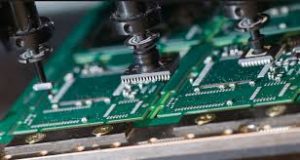
What is a printed circuit board assembly?
Surface mount technology (SMT) has become the predominant method for mounting components onto PCBs due to its efficiency and suitability for miniaturized designs. In SMT, electronic components are soldered directly onto the surface of the PCB, eliminating the need for leads or wires. This results in a more compact and lightweight assembly compared to through-hole technology.
Through-hole technology (THT), although less commonly used today, still has its applications, particularly for components requiring extra mechanical support or high power handling capabilities. In THT, components are inserted into pre-drilled holes on the PCB and soldered onto the opposite side, forming strong mechanical and electrical connections.
Once all components are mounted onto the PCB, the assembly undergoes soldering to create permanent electrical connections between the components and the PCB traces. This can be achieved through various methods such as wave soldering, reflow soldering, or hand soldering, depending on the specific requirements of the assembly.
Quality control is a critical aspect of Printed Circuit Board Assembly to ensure the reliability and functionality of the final product. Automated optical inspection (AOI) and X-ray inspection are commonly used techniques to detect defects such as soldering defects, component misalignment, or shorts, ensuring that only high-quality assemblies are shipped to customers.
The versatility of Printed Circuit Board Assembly extends beyond traditional electronics, with applications ranging from automotive and aerospace industries to medical devices and consumer electronics. As technology continues to evolve, the demand for more advanced and efficient PCBAs will only continue to grow.
In conclusion, Printed Circuit Board Assembly is the process of assembling electronic components onto a printed circuit board, enabling the functionality of electronic devices we rely on daily. With advancements in technology and manufacturing processes, PCBA continues to play a vital role in driving innovation across various industries.